SAMURAI 2026: FIVE FAMILY MEMBERS, ONE CHARIOT, SEVEN DAYS ACROSS JAPAN
How a family road trip across Japan became less about the destination and more about the journey together
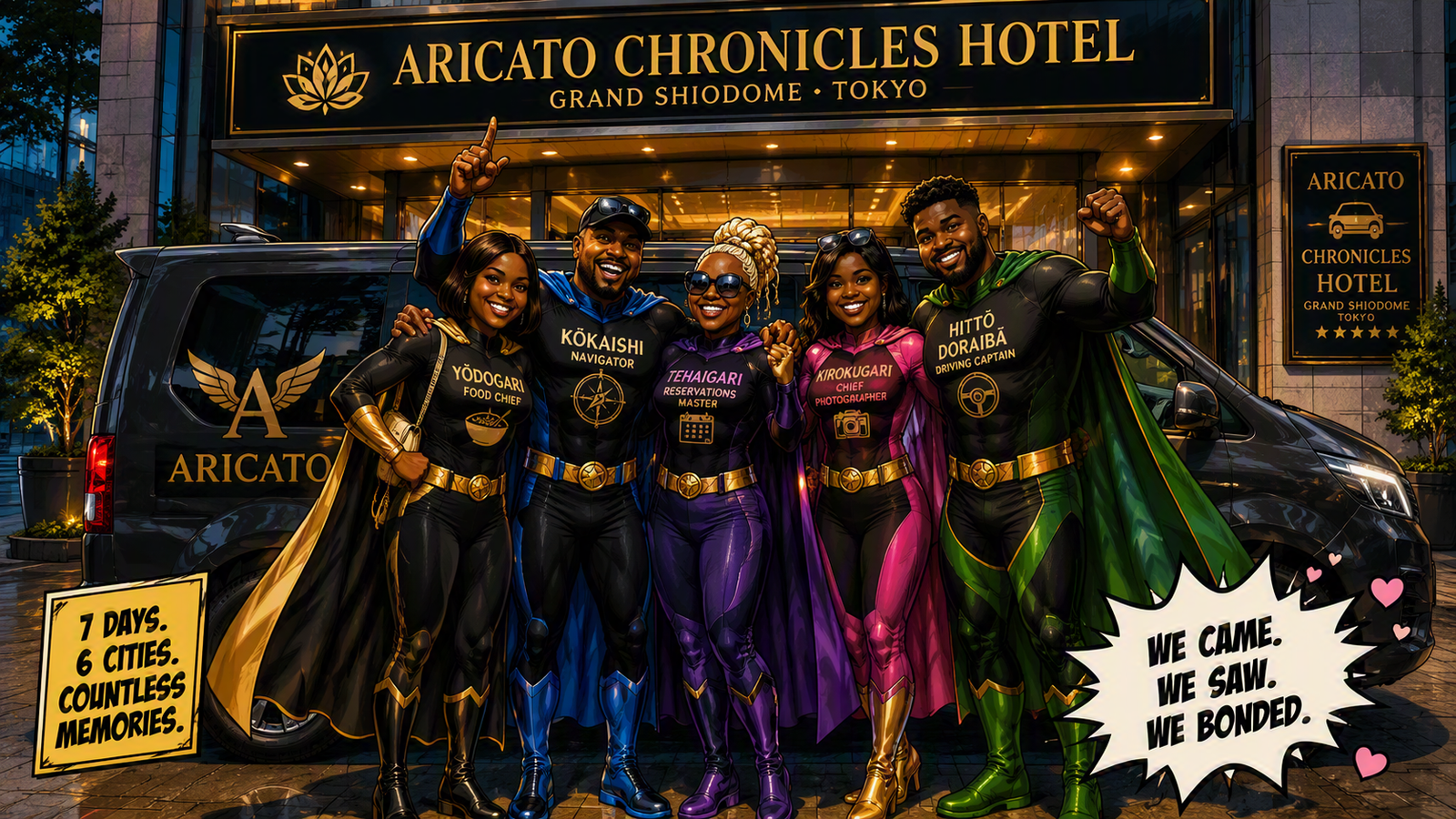
“We came. We saw. We bonded.”
Family life has a habit of scattering people across cities, countries and continents. Careers develop, children grow up, responsibilities multiply, and before long, the people you love most become people you mostly interact with through phone calls, text messages and video screens. It was against that backdrop that the idea of our Japanese family road trip was born. We wanted more than a holiday. We wanted time. Time together.
Time away from routines, obligations and deadlines. Time to reconnect, laugh, annoy one another, argue occasionally and, hopefully, return home with stronger family bonds than when we left.
Why Japan?
The choice of Japan came surprisingly easily. None of the five members of our travelling party had previously visited the country. It was reasonably accessible from the different countries in which family members now lived and offered a practical meeting point. For those of us travelling from the Southern Hemisphere, it also provided a welcome escape from winter.
More importantly, Japan offered something that appealed to all of us. Adventure.Not a resort. Not a cruise. Not a guided group tour. An adventure.
The plan was simple. Fly into Narita from different locations, hire a vehicle, spend seven days driving across Japan, share responsibilities, share costs, share experiences and create memories. Whether we would survive one another remained an open question.
Becoming Samurai 2026
To make the trip more engaging, we assigned everyone Japanese names based on the roles they would play during the journey. Thus, Samurai 2026 was officially formed.
Kōkaishi
Chief navigator, route planner, toll road victim and keeper of departure times.
Yōdogari
Head of food, snacks, hydration and emergency convenience store operations.
Tehaigari
Guardian of bookings, reservations, attractions and accommodation logistics.
Hittō Doraibā
Manager of driving schedules, vehicle safety checks and road trip playlists.
Kirokugari
Official photographer, videographer and custodian of family memories.
Each member also contributed financially according to their ability, though the trip operated largely on the principle that all expenses came from one family purse. No keeping score. No balance sheets. Just family.
The Birth of Aricato
No great road trip deserves a nameless vehicle. After arriving in Narita and collecting our rental van, we retired to the Narita Tobu Airport Hotel where an important ceremonial matter demanded attention.
The vehicle required a name. Suggestions were proposed. Arguments were advanced. Votes were cast
Eventually a winner emerged. Our vehicle was officially christened Aricato.
A naming ceremony followed, complete with speeches, laughter and a failed attempt to convince Yōdogari to provide libation for the occasion. Had this occurred in Nigeria, cultural sanctions may have followed. Had it occurred in feudal Japan, it may have ended with hara-kiri. Fortunately, Aricato accepted her name graciously and carried us faithfully throughout the journey.
The best journeys do not begin when the vehicle moves. They begin when a group of people decide to become a team.
Mount Fuji, Pagodas and Family Politics
The journey truly began as Aricato departed Narita and headed for Fujikawaguchiko. The first major drama arrived before the day had properly begun.
While a determined search effort was being undertaken throughout Terminal 2, one member of the travelling party was happily waiting in Terminal 1. The fact that international airports label terminals with numbers apparently proved insufficient guidance. Eventually, everyone was reunited and the adventure continued.
The day delivered stunning views of Mount Fuji, the christening of Aricato, endless laughter and our introduction to Japanese roads. It also delivered approximately 400 steps to the Chureito Pagoda. There remains a body of opinion within the travelling party that Tehaigari selected this destination specifically to expose the physical limitations of some family members. The plan failed.
Everyone survived. The reward was a spectacular view overlooking Mount Fuji and one of the most memorable moments of the trip. The Pagoda carried a message calling for a peaceful world free from conflict. It was a noble aspiration, though somewhat at odds with the small-scale conflict already developing between certain members of Samurai 2026. Fortunately, diplomacy would ultimately prevail.
Through the Mountains of Japan
Leaving Fujikawaguchiko, the team quickly discovered that Japan is perhaps one of the greatest engineering laboratories on earth. Mountains dominate much of the landscape. Where mountains blocked progress, Japan drilled tunnels through them. Where valleys interrupted progress, bridges appeared. Where rivers objected, ingenious engineering solutions followed.
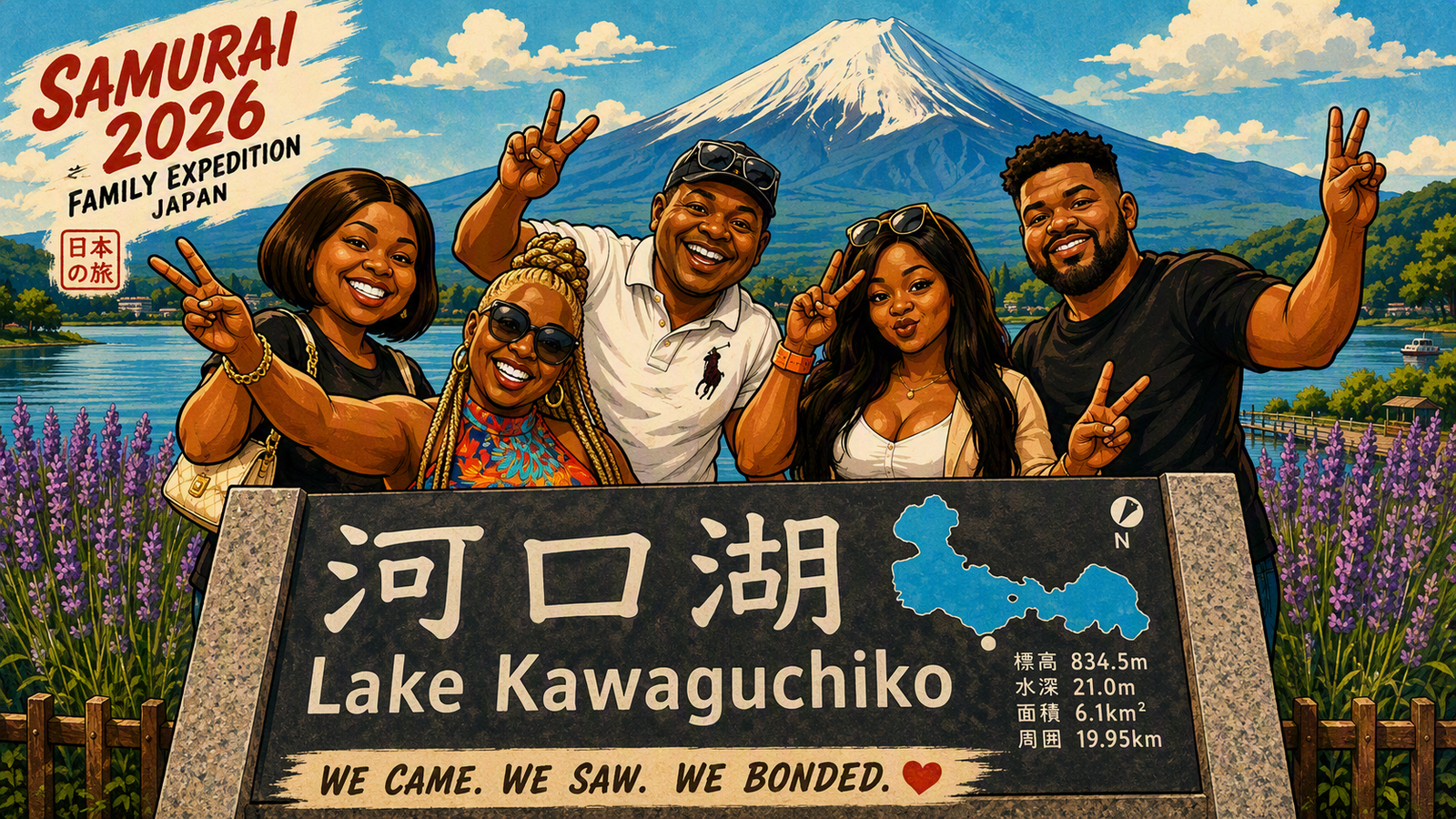
The scenery was consistently breathtaking. At Lake Kawaguchi and Oishi Park, conversations ranged from photography and family history to a fascinating theory offered by a fellow Nigerian tourist regarding ancient Edo chiefs somehow influencing Japanese language and culture centuries ago.
I listened carefully. I smiled politely. And I concluded that believing such theories was entirely at my own risk.
The drive itself offered a constant stream of discoveries: small towns nestled between mountains, rice paddies surrounding homes, roads threading through valleys and landscapes so pristine they appeared curated.
The toll charges, however, remained under active family review.
Kyoto: Temples, Kimonos and Parking
Kyoto introduced us to another side of Japan. Ancient shrines. Traditional architecture. Historic streets. And parking challenges worthy of academic study.
Walking through Yasaka Shrine felt like stepping backwards through time. Tourists and worshippers mingled beneath ancient structures while visitors offered prayers and left wishes for peace, health and family wellbeing.
It was also in Kyoto that our kimonos made their public debut. Seeing Yōdogari dressed in traditional attire was enough to make some observers wonder whether the earlier Edo-chief theory held more truth than originally believed. The suggestion remains unverified.
Kyoto also taught us another lesson. No matter how ancient a city may be, finding parking remains a modern challenge.
Hiroshima and the Road West
As the trip progressed, Aricato became far more than transportation. She became our conference room. Our classroom. Our debating chamber. Our singing venue. Our occasional courtroom.
The conversations covered chemistry, climate change, Nigerian history, global politics, podcasts, family experiences and future plans. At various points Hittō Doraibā became a chemistry lecturer, Kirokugari developed an interest in Nigerian history, and discussions emerged regarding future family projects that had previously been launched enthusiastically and later abandoned. Nobody was permitted to remain intellectually idle.
Travelling together for extended periods has a unique ability to generate conversations that ordinary life rarely provides.
Fourteen Hours to Tokyo
Every road trip contains one defining day. For Samurai 2026, that day was the drive from Hiroshima to Tokyo. Nearly fourteen hours. One vehicle. Five adults. Endless tunnels. Countless toll gates.
The day began badly when Japanese fuel pumps rejected every financial technology known to mankind. Revolut, Rejected. Wise, Rejected. International credit cards, Rejected. Eventually enough Japanese yen was pooled together to satisfy Aricato’s immediate thirst. The relief was short-lived.
Soon afterwards a disagreement over lane selection developed into the first significant diplomatic incident of the day. No permanent damage occurred. Although several motorway exits suffered collateral consequences.
Traffic volumes increased steadily due to the Obon holiday period, transforming what should have been a long drive into an even longer drive.
The day also featured educational discussions, family debates, navigation mishaps, and one particularly memorable attempt by Kōkaishi to avoid participating in financial discussions by pretending to be asleep. Evidence regarding whether the sleep was genuine remains inconclusive.
By the time Tokyo finally appeared, the collective enthusiasm for motor vehicles had declined significantly.
Tokyo and the Family Court
Tokyo replaced roads with subways and Aricato received a well-earned period of rest. Our itinerary included Sensoji Temple, Tokyo Skytree, Shibuya Sky and the world-famous Shibuya Crossing. The city was energetic, crowded, modern and endlessly fascinating.
Rain, however, had plans of its own. What began as a gentle drizzle soon evolved into a serious downpour, limiting views from the observation platforms but doing little to diminish the overall experience.
Shibuya Crossing proved every bit as impressive as advertised. Navigating the crowds in search of a decent photograph became an athletic event in its own right. No member embraced this challenge more enthusiastically than Hittō Doraibā, who launched across the crossing with the urgency of an Olympic relay runner pursuing glory.
Yet the most memorable event of the day occurred elsewhere. Kirokugari convened what became known as The Family Court of Tokyo. The defendants were her parents. The charges centred on perceived insensitivity and making aspects of the trip unnecessarily difficult.
The prosecution was thorough. The defence less convincing. The proceedings ended with tears, honesty, apologies and reconciliation. In many respects, it became one of the most important moments of the entire trip.
Families do not become closer merely by travelling together. Sometimes they become closer by speaking honestly.
The Final Farewell
All adventures eventually reach their conclusion. Departure day began with another drama. A pearl escaped from Yōdogari’s earring during breakfast. An extensive multinational search operation followed. The pearl remains missing.
Our final activities included a planetarium visit and a sumo performance that may well rank among the highlights of the entire holiday. The performers, Hiro and Koji, delighted the audience and generated enough laughter to sustain the group all the way back to Narita.
Soon thereafter came the final drive. The final goodbye to Aricato. The final gathering at Narita Airport. The final parting of ways. And, inevitably, the tears. Most notably from Kirokugari.
The adventure had ended.
Lessons from Japan
Japan left us with several observations that extended beyond tourism.
Less Can Be More
Smaller houses. Smaller vehicles. More efficient use of space. Japan repeatedly demonstrated that effectiveness does not always require excess.
Waste Is Unwelcome
Water, space and resources appear carefully managed and intentionally used. Efficiency is embedded into daily life.
Even Great Nations Have Challenges
Despite remarkable achievements in engineering, transportation and technology, Japan remains imperfect. Like every society, it continues to address ordinary human challenges. It was a useful reminder that no nation is finished.
Every country remains a work in progress.
The Real Destination
Looking back, I am no longer convinced that Japan was ever the true destination. Japan was simply the setting. Family was the destination.
Over seven days, five adults travelled from different parts of the world, coordinated multiple flights, lived out of suitcases, navigated unfamiliar roads, crossed the country together and accumulated more memories than photographs can adequately capture.
There were disagreements. There was laughter. There were frustrations. There were apologies. There was growth. Most importantly, there was time. Time shared together. Time that modern life rarely allows.
That is why I would encourage every family to consider a road trip together. Not because it will be easy. It will not. Not because disagreements will not arise. They certainly will. But because shared experiences create shared stories.
And shared stories strengthen shared bonds. Years from now, the exact toll fees will be forgotten. The hotel check-ins will fade. Even some of the destinations may blur. What will remain are the memories.
The stories. The laughter. And the knowledge that for one week in Japan, five family members chose each other.
Samurai 2026
We came. We saw. We bonded.
🇯🇵❤️🚗🏯👨👩👧👦
Follow the Samurai 2026 Journey Day by Day
While this article tells the overall story of Samurai 2026, each day of the adventure has its own characters, mishaps, discoveries and lessons.
For readers who would like to experience the journey as it unfolded, the daily dispatches from Kōkaishi can be found below.
Daily Expedition Log
🚗 Day 1 – Narita to Fujikawaguchiko Birth of Aricato, the Great Terminal Incident and the climb to Chureito Pagoda. Read the full story
🏔️ Day 2 – Fujikawaguchiko to Kyoto Lake Kawaguchiko, kimonos, shrines and the Land of Tunnels and Bridges. Read the full story
⛩️ Day 3 – Kyoto Adventures Ancient temples, family debates and lessons from Japan’s old capital. Read the full story
🚗 Day 4 – Kyoto to Hiroshima Aricato heads west as Samurai 2026 settles into road-trip life. Read the full story
🛣️ Day 5 – The Long Road to Tokyo Fourteen hours, countless toll gates and one very tired travelling party. Read the full story
🚇 Day 6 – Experiencing Tokyo Sensoji Temple, Shibuya Crossing and the Family Court of Tokyo. Read the full story
✈️ Day 7 – Departure Day The sumo show, farewell to Aricato and the end of Samurai 2026. Read the full story