Fujikawaguchiko to Kyoto 🚗🏔️⛩️
13 August 2026
Yesterday, I mentioned that the jury remained out on Haostay and that its breakfast would determine its final fate.
The jury has now reconvened and delivered its verdict.
Haostay survives.
Not with distinction, and certainly not because of the breakfast, but because of its immaculate cleanliness, comfortable accommodation, and an exceptionally friendly receptionist who seemed to have mastered the rare art of hospitality.
Before the rest of the team awoke, I took a walk through Fujikawaguchiko. The morning air was crisp, the streets spotless, and the town looked like it had been carefully arranged by an artist. Along the way I discovered several glamping domes offering spectacular views of Mount Fuji. They looked magnificent, but after a closer inspection I became grateful for our own choice of accommodation. Sometimes the beautiful option is not necessarily the better one.
Back at Haostay, our commitment to an 8:00am breakfast and 9:00am departure was immediately put to the test. The team sought a twenty-minute extension which, after negotiations worthy of international diplomacy, was reduced to ten minutes and duly honoured.
Part of the delay could perhaps be attributed to the sudden emergence of an impromptu fashion shoot. Yodogari appeared radiant enough to attract attention from passing satellites while Tehaigari transformed herself into a professional paparazzi, directing poses and snapping photographs with enthusiasm usually reserved for celebrity magazines.
Breakfast itself was functional rather than memorable, but as every traveller eventually learns, something is almost always better than nothing.
Joining us in the breakfast room were our “Taiwanese copycats” from the previous evening. They would soon depart in what appeared to be Aricato’s long-lost twin, complete with the remarkably memorable plate number of 3000. It was comforting to know that even our vehicle had family somewhere in Japan.
At exactly 9:00am, Kirokugari guided Aricato confidently out of the parking lot and towards Lake Kawaguchi.
Naturally, peace did not last long.
No sooner had we begun the day’s journey than Hitto Doraiba lodged a formal complaint. According to him, the drivers had deliberately ignored his carefully researched route, which would have taken us first to Oishi Park where Mount Fuji could supposedly be viewed more clearly.
As is becoming customary on this trip, jaw-jaw prevailed over war-war.
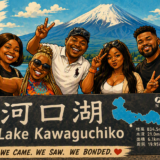
The dispute dissolved almost immediately upon arrival, as we found ourselves standing before one of the most picturesque landscapes of the journey. Beside the park sign, with Mount Fuji silently observing our proceedings, we captured some magnificent photographs.
As we explored further, we encountered a couple who looked unmistakably Nigerian. A few moments of conversation confirmed our suspicions and launched one of those spontaneous expatriate discussions that seem impossible to avoid when Nigerians discover one another abroad.
The scenery around us was beautiful, though I confess the flower displays failed to impress me greatly. This was pleasant enough, but it was certainly no Keukenhof Gardens.
Our newly acquired Nigerian friends then proceeded to explain that similarities between certain Japanese words and Edo expressions were evidence that an Edo High Chief must have visited Japan centuries ago and left behind both linguistic and cultural influences.
I listened carefully. I smiled politely. And I decided that believing this theory was entirely at my own risk.
Leaving Fujikawaguchiko was surprisingly emotional. Over two days the town had charmed us with its serenity, breathtaking scenery and slower pace of life. We departed grateful for the experience and hopeful that our paths might someday cross again.
Music accompanied much of the drive. Unlike the previous day, songs were allowed to finish naturally instead of being interrupted midway through their emotional journeys. Particular appreciation therefore goes to our DJ, whose selection produced perhaps the most enthusiastic vehicle-wide singalong so far when Whitney Houston’s I Wanna Dance with Somebody filled Aricato. Even tttusualy reserved Hitto Doraiba emerged briefly from his protective shell and joined the chorus.
Perhaps the greatest surprise of the day came when Kirokugari introduced what can only be described as a photographic emergency.
Each traveller was t choose a colour and instructed to photograph at least ten examples of it throughout the day. My chosen colour was black. By now we have learned that assignments issued by Kirokugari are not optional.
As a result, five otherwise sensible adults began photographing passing vehicles, railings, signs, poles, watches and miscellaneous objects with a determination that would have puzzled any observer.
At Shimada City Central Park, the driving baton was passed to Tehaigari. Immediately, the atmosphere changed.
Before long she casually enquired how fast each of us had ever driven. One by one, numbers were provided. When she eventually shared her own adventures between Canberra and Melbourne, we became concerned rembering th chritian hymnal – this world is not my home, I’m just a passing through
This concern was reinforced when a motorcyclist overtook us and I could almost see Tehaigari physically resisting the urge to unleash Aricato’s concealed racing pedigree.
Fortunately, wisdom prevailed.
Mostly. As we continued westward, we passed Nagashima Spa Land. Its giant roller coasters rose dramatically above the horizon like mechanical mountains. Combined with the tranquil waters of the Kiso and Ibi Rivers flowing towards Ise Bay, the scenery was remarkable.
The discussions in Aricato were equally enlightening.
I learned that Kyoto and Tokyo contain exactly the same letters. I learned that Kyoto once served as Japan’s capital.
We discussed the Kyoto Protocol and climate change. We revisited Newcastle and coal.
And somewhere in the middle of all this, I managed to confuse Nagoya with Okinawa while fantasising about obtaining my own Hattori Hanzo sword thanks to excessive exposure to Kill Bill.
Eventually, a strategic conspiracy was initiated. Around thirty minutes before Tehaigari’s allotted driving time ended, a coordinated operation persuaded her to pull into Neopasa Okazaki so that Aricato could receive refreshments.
Refuelling should have been simple. It was not.
Fearful of accidentally introducing the wrong fuel into our beloved chariot and facing financial consequences severe enough to impact future generations, we summoned professional assistance.
From the attendant we learned an important lesson. In Japan, the fuel cap is colour coded.
Green cap. Green nozzle. Diesel.
Elegant simplicity.
Aricato rewarded our efforts by immediately consuming almost one hundred dollars’ worth of fuel. At this point she had personally eaten and drunk more than any single member of the travelling party.
By late afternoon we arrived in Kyoto and proceeded directly to the magnificent Yasaka Shrine.
Passing through the towering vermilion Torii gate was like stepping into another world. For over 1,300 years people have entered this sacred space seeking peace, guidance and blessings.
As we moved through the grounds, one observation kept returning to me.
No matter the religion, people seem remarkably willing to part with money whenever the divine becomes involved. Coins landed softly around prayer areas while worshippers quietly expressed hopes, fears and gratitude.
Time was against us, so after capturing several memorable photographs we moved on in search of sustenance.
This led us to Salmon Noodle Kyoto, an unassuming restaurant that delivered surprisingly excellent food served in bowls that looked almost ceremonial.
The only problem was quantity.
The portions were so modest that the meals appeared designed for people with much smaller ambitions than ours.
We left satisfied but unconvinced.
After one unsuccessful attempt to visit another temple before closing time, we eventually made our way to Travelodge Shijo Karasuma.
The navigation through Kyoto’s narrow streets was another demonstration of Tehaigari’s driving skill. She manoeuvred Aricato through spaces that appeared several centimetres narrower than the vehicle itself and delivered us safely to our destination.
As evening approached, we ventured into the bustling Shinkyogoku Shopping District
Here, enterprise was on full display.
Restaurants, boutiques, shrines, souvenir stores and traditional clothing shops competed enthusiastically for tourist attention.
It was also here that Tehaigari nearly created an international incident when a small cockroach unexpectedly took flight. What followed involved a scream, evasive manoeuvres and behaviour unlikely to be seen in official tourism brochures.
Fortunately, no stampede occurred.
Yodogari soon became captivated by a kimono store. Watching her dressed in traditional Japanese attire, I began to wonder whether the earlier Edo High Chief theory perhaps deserved slightly more consideration than I had initially granted it.
The day concluded with another important Kyoto lesson:
Parking is not for the faint-hearted.
After multiple unsuccessful attempts, one apparently promising parking space was rescued from becoming a very expensive mistake when modern technology translated a Japanese notice informing us that the area was reserved exclusively for dental patients.
Eventually, the two ladies, assisted by Kokaishi, secured a public parking space and completed the final seven-minute walk back to the hotel.
Before closing, I return to a moment from Yasaka Shrine.
Near the administrative buildings stood thousands of ema, the wooden prayer plaques on which visitors write their hopes and wishes. People from every nation, language, faith, ethnicity and background had left messages there.
Yet despite all our differences, the themes were remarkably similar:
Love. Peace. Health. Family. Safety.
It reminded me that humanity is perhaps not as divided as the news sometimes makes us believe. And it reminded me how fortunate we are. Five members of one family.
Travelling together.
Learning together.
Laughing together.
Occasionally arguing together.
But ultimately sharing experiences that will remain with us long after this journey ends.
So, to each of you:
Thank you.
I love you.
And thank you for everything you bring to our family.
Yours,
Kokaishi🚗⛩️🏔️❤️