WHEN TAX POLICY MANUFACTURES CORRUPTION
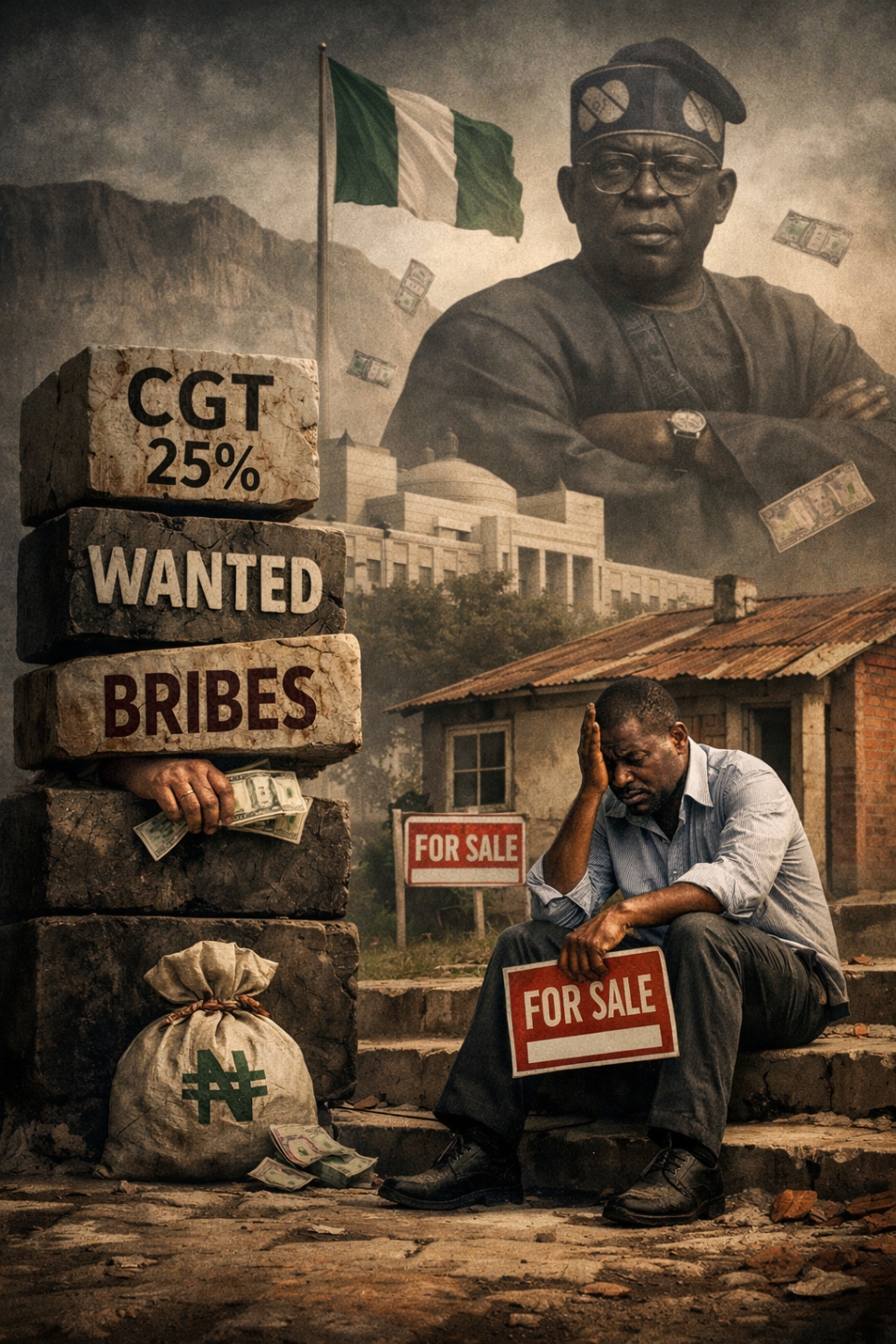
A friend sat me down recently and shared a story that has refused to leave my mind. It is not fiction. It is not exaggerated. It is the quiet, grinding reality that many Nigerians now face — a reality created not by fate, but by policy.
Eleven years ago, he bought a piece of land for N20 million. It was his retirement plan, his hedge against uncertainty, his one solid anchor in a country where stability is a luxury. He held on to that land through recessions, currency crashes, and the hyperinflation unleashed by policy decisions that punished savers and rewarded speculators.
But life has become brutally expensive. His income has not kept pace with the cost of living. The Naira has been devalued beyond recognition. And so, reluctantly, he decided to sell the land.
The market value today: N77 million. On paper, it looks like he has made a killing. In reality, he has been killed.
First, the agent facilitating the sale insisted on taking N2 million as commission. He accepted it — what choice did he have? But the real blow came next: the new tax law, effective 1 January, demanding 25% Capital Gains Tax on the “profit.”
He paused and asked the obvious question: What profit?
When he adjusted his original N20 million for inflation, its real value today is N128 million. That means that instead of gaining, he has lost N50 million in real terms.
But the government doesn’t care about real value. It only cares about nominal figures.So they insist he owes CGT on the difference between N77 million and N20 million — a fictional gain. A phantom profit. A tax on money he never made.
His CGT bill: N14 million.
He told me he screamed — literally. His neighbours rushed in, thinking something terrible had happened. Something had.
If he pays the tax, he walks away with N60 million, less than half of the inflation‑adjusted value of his original investment. The system has already impoverished him, and now it demands tribute for the privilege.
Then came the part of the story that made my stomach turn.Someone whispered that they “knew someone who knew someone” in the tax office. A few calls later, the message came back: If you can pay N5 million, your N14 million problem will disappear.He is a principled man. He hates corruption. But he is also a rational man. And he asked me — with a pain I could feel in his voice — “Is a system that destroys my savings and then taxes my losses a system I owe honesty to?”
I remembered Gani Fawehinmi’s warning: “In a state of lawlessness, it is illegal to be law‑abiding.” My friend rephrased it: In a state of injustice, it is illegal to be just.And he is right.
This is how corruption is manufactured — not by the moral weakness of citizens, but by the moral bankruptcy of policy. When government taxes nominal gains in a hyperinflated economy, it is not enforcing fairness; it is enforcing desperation. It is pushing honest people toward dishonest choices. It is punishing prudence and rewarding manipulation.
So I ask you, as I have been asking myself since he told me this story:Is it right — or even moral — for government to tax a nominal gain when real value has been destroyed?
Because if the answer is no, then the real scandal is not the citizen tempted to “play ball.”
The real scandal is a tax system that makes corruption the only rational survival strategy.
What would you do.