
Prologue
This is a work of fiction. Names, characters, businesses, places, events, and incidents are either the product of the author’s imagination or used in a fictitious manner. Any resemblance to actual persons, living or dead, or actual events is purely coincidental.
The early morning call to prayer was a daily ritual in Ibadan, a practice deeply rooted in Islamic faith. As the city evolved from a war camp into a thriving trade hub, particularly with the Hausa people, Islam flourished.
Each dawn, the pre-dawn silence was shattered by the rhythmic chant of the “Alfa”, amplified by the Ahuja horn loudspeaker. This resonant call to prayer, or adhan, echoed through the city, beckoning the faithful to commence their daily prayers.
As the Alfa’s call echoed through the streets, Ibadan began to stir. Residents emerged from their homes, wrapped in prayer rugs, and made their way towards the nearest mosque. The once-quiet streets filled with the sound of footsteps and hushed conversations as people prepared for the morning prayer.
Moriamo, affectionately called Moria, a young girl with a heart full of dreams, was roused from her slumber by her mother, Nasifa. She had slept through the morning call to prayer, her usual alarm. It was time to help her mother with the food-selling business before the morning rush.
Little did she know that this would be her last morning in that small room she shared with her parents. As she rose from the mat, she knelt and briefly greeted her father and mother. They lay on a foam mattress, separated from her sleeping space by a simple curtain. Had she known, she would have taken a moment to appreciate the simplicity of their shared space truly and hugged her parents a little tighter.
She stepped out of her mud-clay house, its walls smoothed with a layer of cement. Feeling fortunate compared to some of her schoolmates, she made her way to the stall less than a kilometre away behind Mapo Hall. There, she retrieved a giant pot and placed it on the Adogan, a simple fireplace of three stones.
Kindling the fire was a surefire way to wake up, even after the morning walk. She tore some Ogusho and placed them among the firewood. Striking a match and blowing gently, she coaxed the dry wood into flame. The emerging smoke triggered her cough and made her eyes water and redden, but it was a necessary task before heading to school.
With the fire crackling, she turned to the Amu, a large clay pot used for storing water. Dipping into the water she had fetched from the mosque the night before, she poured it into the pot. Carefully measuring the rice, following her mother’s instructions, she added it to the boiling water.
Their family’s food-selling business was booming. The previous day, they’d sold out their entire stock ahead of schedule. Civil servants, drawn by the tantalising aroma of steaming rice piled high in a basin, would place their orders with her mother. Some would add beans, plantain, or eggs, while others opted for a generous serving of fiery stew and assorted meats, depending on their budget. These customers would then settle at the long timber table and bench, crafted by her father, Alimi, a skilled carpenter.
The income from this bustling business helped her mother shoulder household expenses, ensuring a steady supply of food and other necessities. Her mother would soon join her, but first, she had to wash the dishes and measure out the Elubo for the Amala that her mother would prepare and sell to their customers at lunchtime.It was this mundane task that was interrupted by the sharp cry of Mama Rafia, their neighbour. She shouted for everyone to shut their shops and run.
In Ibadan, Mapo Hall, a grand edifice perched atop a hill, reminds all about the city’s colonial past, modelled after St. George’s Hall in Liverpool. In the late 1960s, the hall’s imposing presence dominated the surrounding landscape. Its majestic architecture, characterised by columnar facades and intricate detailing, was a sight to behold.
It offered visitors a sweeping panorama of the city below. From its elevated position, the grand hall stood as a silent witness to the vibrant, chaotic life of the metropolis. Inside, its corridors and chambers hummed with the constant flow of people—politicians, students, merchants, and citizens—each contributing to the building’s rich, human atmosphere. The air was a thick blend of sweat, perfume, and the faint, savory scent of food from nearby stalls.
This was more than just a building; it was a stage for history. In 1948, the Ibadan Conference brought together Yoruba leaders from across Nigeria, and it was here that Chief Obafemi Awolowo delivered the powerful speech that launched his career. Seven years later, in 1955, the National Council of Nigeria and the Cameroons held its annual convention in this very hall, featuring a presidential address by Nnamdi Azikiwe.
Yet, this hallowed space also bore the scars of conflict. In late November 1968, as the dry Harmattan winds began to blow, the hall became the target of the Agbekoya uprising. As the headquarters for the Ibadan City Council, which administered the very taxes that had sparked the revolt, the building symbolized the government’s oppression. Steeped in the belief that “those who make peaceful change impossible make violent change inevitable,” the Agbekoya stormed the hall. They felt that if peace had been denied to them, the government should find no peace either. In their eyes, the building was not just an office, but an emblem of the injustice they were determined to bring down.
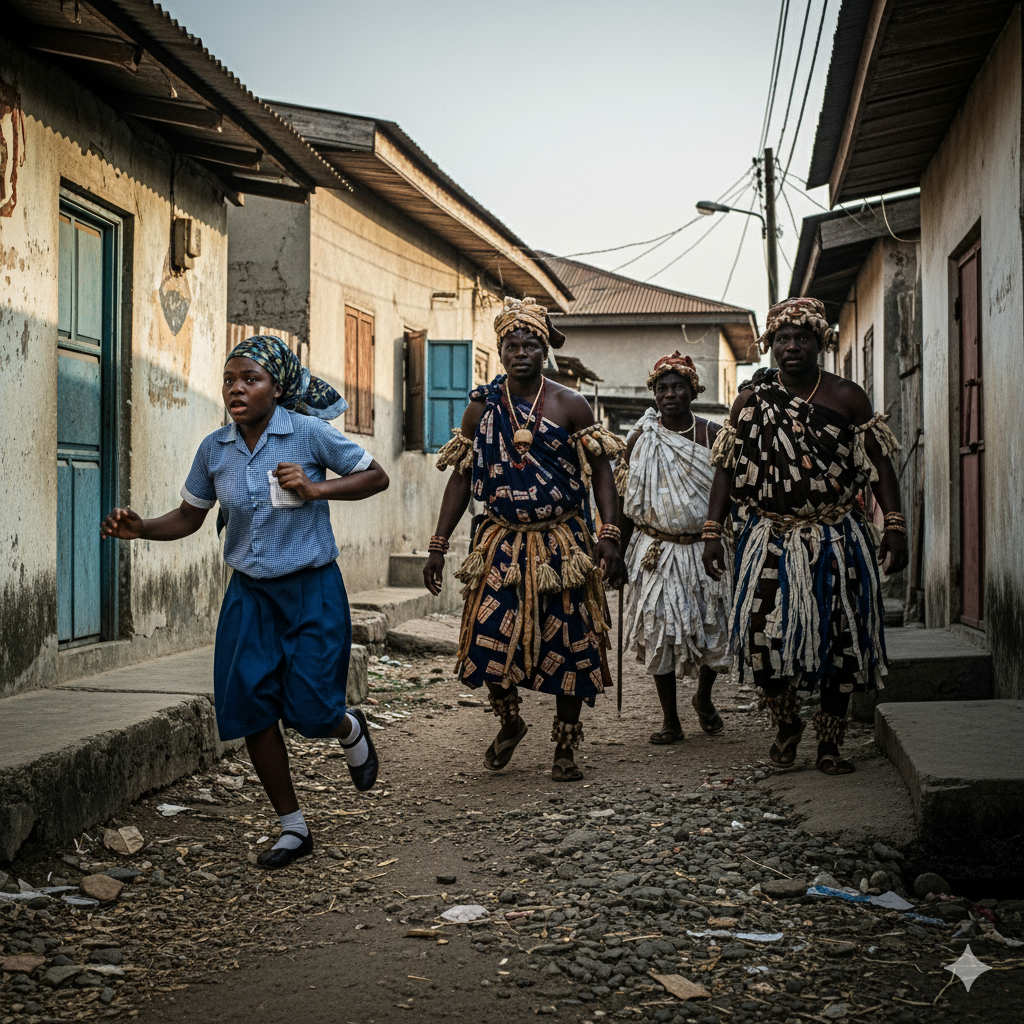
The cry of “Egbami, mogbe!” was what Moria heard that alerted her that something was off. A surge of panic swept through her as she saw, coming towards her, a group of men, dressed in frightening clothing and armed with cudgels, machetes, clubs, and other unfamiliar weapons. They were scattering everything on their way.
Before Moria could close the shop, the Agbekoya men were upon her. Seeing their menacing appearance, the Ewu-Etu worn and the assortment of charms they carried, her heart pounded with fear. She abandoned everything and fled for her life, stumbling into a ditch and breaking her right foot. The pain was excruciating, but she stifled her cries, too terrified to make a sound. Unbeknownst to her, the Agbekoya were not targeting people like her. She was merely caught in the crossfire of their anger.
As she lay there, struggling with the pain, she noticed a figure hidden behind an overturned table, not far from her. It was a man wearing a cassock and a clerical collar. He also could see Moria and had witnessed her dashing out of the stall and running without looking into the gutter. He beckoned to Moria to be patient; he was too afraid to get out of hiding to Moria’s help.



Olu Ajayi
This will be an interesting story. I particularly love how actual Yoruba words are used to describe places and things.
Kudos Bimbo 👍👍
bimbo
Thank you very much, pleased that you find it interesting already. Stay tuned as the event unfolds
AKEEM A ADEDEJI
Try to use the word Muezzin, the common name for the people who make the call to prayer in Islam, you may then clarify as ” commonly known as alfa by the Yorubas.” Also, try to give a closer English word for Aso- etu for non-Yoruba speakers. Otgerwise, very interesting and enjoyable to read.
bimbo
Feedback taken, thank you. I really struggle with finding the right English words to use for some unique Yoruba words, for instance Aso-Etu!
San Chukwuemeka
Wao! Well done. This is already getting interesting and you’ve got me hooked.
bimbo
Hi Sam, thanks for your feedback. I am positive you’ll enjoy the story. More to come.
Blessing
This is an interesting read
The attention to details is profound.
Welldone, sir.
bimbo
Thank you Blessing, just trying my hand out there on hidden stories that needed to be told. Looking forward to read pieces from you as well.
Blessing
I’ll do more of political writing, and I’ll definitely share my pieces with you.
Ifaturoti Sola
You have captured the readers interest from the beginning. Good work 👍
bimbo
Ore, thank you sir.
Oluyinka Adediji
Hello Bimbo.
I like the setting and the background with brief references to Ibadan and he historical role in the emergence of Nigeria, the simple family , and religious milieu of our people .
The early introduction of Moria , the warriors and the ‘ Good Samaritan ‘ make me belief that your emphasis would be on the consequences of this conflict rather than its cause and execution. I will wait for the rest . I was four years old when this conflict broke and I was sitting on my fathers lap while critical meetings were heals at our village a few miles from Adeoye.
bimbo
Ore, thank you for the feedback. Your expectations will be fulfilled.
Ohanugo Ernest
Looking forward to the next chapter. My curiosity is piqued.
Bobo Yen
Nice piece, waiting for the next one
bimbo
Thank you, Baba Ibadan. Being from Ibadan, I am sure you’ll enjoy the story as it unfolds.
Muyiwa Alabi
Can’t remember the last time I heard the word “adogan” and “ogusho”. Lol.
Nice and easy read
bimbo
Thanks Muyiwa, another way to keep the Yoruba language alive for posterity.
Laide Adenuga
What a story? I can see some commonalities with what happened to a friend during the ‘Ai Must Go’ riot. Moria, not seeing the parents again till they died…what a shame?
You are a very good story teller. Well done.
bimbo
Thank you Laide, I am encouraged
Jehoshaphat Milany
Olu, wao! What a story mate? Could you interprete some of those words that are not in English?
bimbo
Taken note. In the published one, will ensure this is done
Raheem, Musa Ariyo
Good presentation
However, I was thinking as this chapter was an introductory to the Agbekoya episode, an introduction to what is Agbekoya and the formation of Agbekoya could have been mentioned.
Hopefully my expectation will be met as we read on.
Thanks
bimbo
Fair comment. I thought as much but instead of putting it in front I chose to gradually unwrap it for the reader.
The challenge 2ith the event is how to make it easily digestible for our Gen z. To do this, I am compelled to take it off the usual presentation in form of an history lesson.
Olumuyiwa Agboola
Very interesting prologue written in beautiful, flowing prose! It whetted my appetite for the next chapter. Well done!
In the second paragraph, you mentioned that the residents emerged from their houses wrapped in prayer rugs. Were they wrapped in prayer rugs or holding prayer rugs or mats, as the moslems do when going to the mosque?
bimbo
They usually carry them sir, I used wrap, figuratively but could change it.
Thank you so much sir, for the feedback
Abiola Nnaobi
Well written. Filled with suspense. Please when will we read the rest? Please reserve a copy for me.
Elena
Really good read. Had me gripped from the beginning. It wasn’t a slow start. Really good, descriptive,, vivid, nostalgic.
👍 Like it.
Oludayo Oluwole Ogunbade
The prologue is very interesting and portending a good story. I like the way the writer mentioned that the protest is not targeted at people like Moria, but fear made her to run and hurt herself.
The mentions of local names/slangs/phrases like Adogan, Gusto etc. are very interesting.
Please incorporate the wake-up call of the Mosalasi into the book, “Allahu Akubaru……
bimbo
Ore, I am laughing here ooo. For more than 5 years, I was constantly listening to the wake-up call as my alarm to rise up in the morning. There were two mosques tht helmed our house in-between them. You can understand what that means.
Abiola Adedeji
Well written script Bimbo. The description of surroundings of Ibadan is vivid and you can practically see it. Let see how the story develops. Definitely a good read.
bimbo
My Presido, thank you sir.
TIAMIYU Sulaimon Gbola ST Lagelite 84
This is amazing and interesting especially by taking us to early days of our lives. Wishing you are success in your sojourn on this assignment.
bimbo
Thank you sir.
Lola Bakare
Uncle Bims !! I couldn’t stop reading it ! It transported me to Ibadan and I could smell the rice and stew and felt the gut wrenching fear radiating 😳. This piece is a thoughtful, emotionally layered, and historically grounded narrative that captured the tension between daily survival and societal upheaval in a uniquely Nigerian context. The juxtaposition of the intimate and the political, the domestic and the historical, makes it both instructive and moving. With slight refinements in pacing and character depth, it could serve as a compelling excerpt in a larger work—be it historical fiction, memoir, or educational literature. I loved every line and I can’t wait to read the rest of it. Kudos !! Phage been privy to some of your writting so I am not surprised 😁
bimbo
Lola,
Oga ju. All these words for this? Oyinbo po. Thanks a lot, I am highly honoured.