
There is a popular Waffi proverb that says: “Monkey no wise, na tree near tree.” Translated for the refined audience: a monkey is not a genius; it just happens to know which branches won’t break under its weight. In other words, what looks like absolute madness to an outsider is just standard operating procedure to the locals.
If you don’t know the terrain, you will pay dearly for your ignorance. And by “pay,” I don’t mean small change. I mean two live goats. This is the story of how my parents learned that lesson the hard way in Ode-Ekiti, as told to me by my mother.
Welcome to Ode-Ekiti
Ode-Ekiti isn’t a household name like Lagos, Ibadan, Kano, or Port Harcourt. But if you’ve been around as long as I have, you’ll know the town punch well above its weight—not least through notable indigenes like the legendary Aluko family.
This is the land of the Semuregede Festival, held in honor of the Oloke deity to signal the eating of new yams and invoke peace, protection, and prosperity. Traditional matters in Ode are not a joke. (In fact, fast-forward to 2003, the King himself, Ọba Samuel Adara Aderiye, was dethroned right in the middle of the Semuregede Festival because his Christian faith wouldn’t let him perform certain traditional rites. It took him four whole years of legal and political wrestling to reclaim his throne. So you see? In Ode, custom does not care about your personal feelings.)
But our story today is not about the King’s dethronement. It happened much earlier—six decades ago.
My father was a schoolteacher, posted to the town like many educated professionals of that era. My mother was a young stay-at-home housewife trying her best to navigate a town where she didn’t speak the dialect fluently. Our household was simple: My dad, my mum, baby me, and the family dog.
The Unfortunate Incident
Those were the golden days when children could play outside while the dog kept a lazy eye on things.
On this fateful morning, my father had gone to school to teach. I was outside playing, and our dog was hanging around. Suddenly, for reasons best known to canine psychology, the dog decided to go on an excursion. It wandered all the way to the busy interstate road on the outskirts of town.
Enter tragedy.
A speeding vehicle hit the dog. The impact was fatal. The driver, displaying typical hit-and-run courtesy, did not even tap his brakes. He hit the accelerator and zoomed off into the horizon, leaving our family pet lifeless by the roadside.
Enter the Well-Meaning Student
Now, fate decided to mix this soup.
One of my father’s students happened to be walking past. He saw the dog, recognized it immediately, and gasped: “Ah-ah! Is this not Teacher’s dog?”
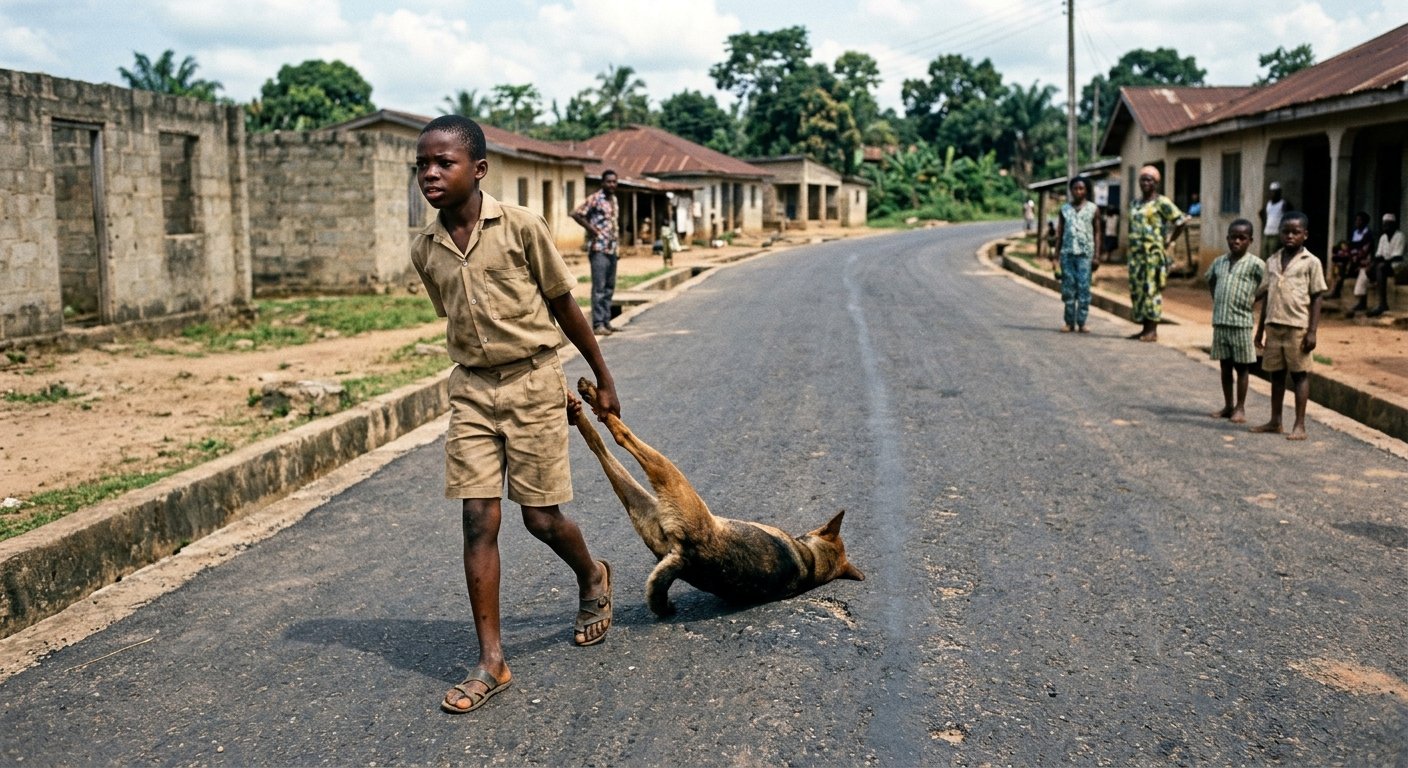
Driven by pure respect and a desire to be the teacher’s pet, the boy grabbed the heavy, lifeless dog by the hind legs and began the long, sweaty trek back to our house. Imagine the scene: a young boy in school uniform, dragging a whole dead dog through the streets of Ode.
Just as he was turning into our street, a woman spotted him. She took a critical look at the dog, adjusted her wrapper, and asked, “My boy, what are you doing with that dog?”
The student replied, “It’s my teacher’s dog. Car hit it on the main road.”
Now, let us pause. In many parts of Nigeria at the time—and even now—fresh meat is fresh meat. Seeing a whole carcass, the woman’s eyes lit up like someone who just won the lottery.
“Ah! If your teacher’s family doesn’t want it, tell them to give it to me o!”
The student, refusing to take executive decisions on behalf of his teacher, told her to follow him home to ask my mum directly.
The “Unpardonable” Sin
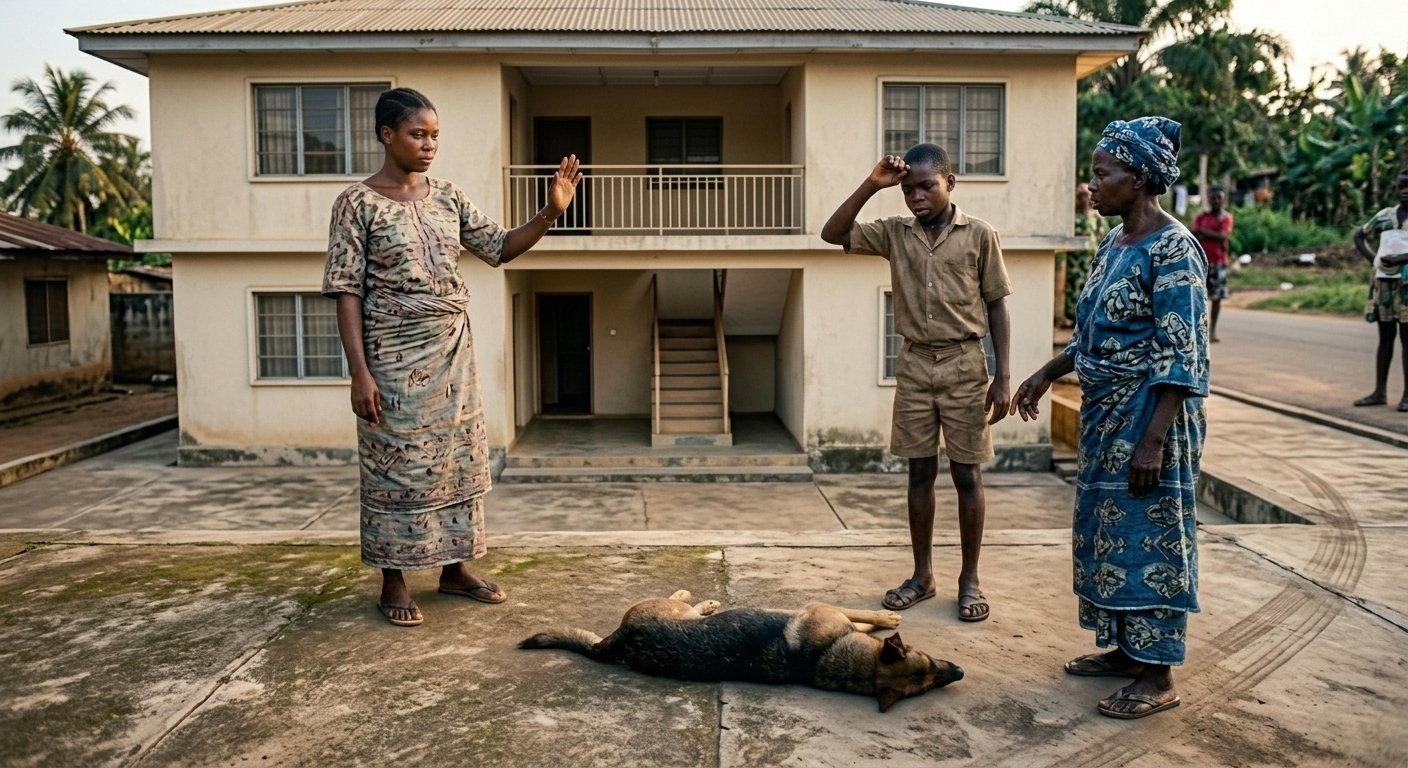
When my mother came out to answer the knock, she met a strange woman, a sweaty student, and her dead dog lying on the dirt.
My mother was naturally sad about the dog, but what was done was done. She had zero interest in keeping a dead animal. So when the strange woman politely asked if she could have the carcass for dinner, my mother waved her hand casually:
“Take it. No problem.”
The woman sang my mother’s praises, grabbed her prize, and hurried off to light her stove.
Case closed, right? Wrong. My mother had just committed a geopolitical offense of inter-compound proportions.
The Law of “Finders Keepers”
What nobody bothered to explain to my young, non-indigene mother was the unwritten customary law of the neighborhood.
The dog had been hit and thrown right in front of another woman’s compound near the main road. According to local belief, any animal—domestic or wild—that drops dead in front of your house is not a tragedy; it is divine provision. It is manna from heaven. It belonged to the owner of that compound by traditional law.
That woman had already spotted the dog from her veranda. She was probably inside her kitchen fetching a sharp knife and a big pot when the student arrived, grabbed the dog, and dragged it away.
She came out, saw that her “divine blessing” was gone, and tracked the trail of blood and dust all the way to our street. And what did she discover? That my mother—a stranger—had given her god-given dog to another woman!
To her, this was not a mistake. It was a calculated, deliberate, public insult to her lineage.
A Royal Summons
Without wasting a single second, the aggrieved woman tied her wrapper tightly around her waist and marched straight to the Palace.
“Your Royal Highness! A stranger in our land has robbed me of my divine blessing and given it to my rival! They have insulted my household!”
Before my father could finish marking his students’ exercise books at school, a royal summons arrived. He was ordered to report to the Palace immediately with his wife.
My poor father was utterly confused. A dead dog? In the King’s palace?
They arrived at the palace, met by solemn-looking chiefs and a furious complainant. My parents explained everything:
- “We are strangers.”
- “We didn’t know the rule.”
- “The student brought the dog to us.”
- “My wife acted out of pure innocence!”
The King and his council listened attentively. They nodded. They reasoned among themselves. Then, the King cleared his throat and delivered the verdict:
“We hear your explanation. You acted without malice. However, custom is custom, and an insult has occurred under the laws of this land. To restore peace and wipe away the insult, you must provide two live goats and a formal apology.”
The Price of Peace
Two live goats! For a dog that was already dead!
For a schoolteacher on a government salary, buying two healthy, live goats was a heavy financial blow. But as strangers living in a deeply traditional town, my parents knew better than to argue with the Oba and his chiefs. Peace in the community was worth far more than pride—or money.
And so, two heavy, healthy goats were handed over—alongside a formal apology delivered with complete humility.
Now, let us be clear: my parents did not cough up those two goats because they felt guilty. They didn’t do it because they had any wicked intention in their hearts, nor did they do it because the logic of the judgment made sense to their non-indigene brains.
They complied simply because peace will always matter more than pride.
They recognized that when you are a guest in a land deeply rooted in tradition, you respect the customs of the soil—even when those customs leave your head spinning and your wallet lighter.
The apology was offered. The goats were accepted. The aggrieved woman accepted the settlement, adjusted her wrapper, and offered one final, ominous piece of advice:
“Next time, be careful.”
And just like that, the curtain fell, and the case of the roadkill dog was closed.
The Anatomy of a Cultural Collision
What fascinates me about this entire saga isn’t just the dog, the goats, or even the grand court drama at the Oba’s palace. What gets me every time is how a chain of completely innocent, well-meaning actions managed to trigger a full-blown communal dispute.
Look at the dominoes falling:
- A dog went on an unsupervised morning stroll.
- A reckless driver hit the dog and zoomed off without remorse.
- A dutiful student tried to do a good deed for his teacher by dragging the body home.
- A passing woman saw fresh meat and asked for what nobody wanted.
- A young mother generously said, “Take it!” to clear her compound.
Every single step in that chain was guided by normal, reasonable logic. Yet, all those good intentions crashed headfirst into an unwritten cultural rule that my parents didn’t even know existed.
Today, corporate consultants and HR executives like to wrap this concept in fancy vocabulary like “cultural awareness” or “cross-cultural competence.” But our ancestors knew it by a far simpler truth: before you step into a forest, learn the names of the trees.
Conflicts do not always brew from bad intentions or malicious heart. More often than not, they explode from unseen assumptions, wildly different worldviews, and ancient customs that one group takes for granted while another is completely blind to.

Famose Adewale Pratt
What a culture
Olusegun Ajayi
“The dog had been hit and thrown right in front of another woman’s compound near the main road. According to local belief, any animal—domestic or wild—that drops dead in front of your house is not a tragedy; it is divine provision. It is manna from heaven. It belonged to the owner of that compound by traditional law.”
👆👆👆Professor, Author, FCA, Sheikh:
Thank you for this beautifully written story.
However, my question is that does that mean that dog 🐕 is a delicious delicacy for Ode-Ekiti people like the Ondo Egin’s and Calabar people 💁💁🙄😳
May your ink ✍🏽 never dry laelae
Yinka Bakare
A fantastic, intelligent and interesting write up.