The Bird on a Wire
This is a work of fiction. Names, characters, businesses, places, events, and incidents are either the product of the author’s imagination or used in a fictitious manner. Any resemblance to actual persons, living or dead, or actual events is purely coincidental.
At the restaurant, while awaiting her food, she read through her notes, the words blurring until one name, Sam Okafor, stood out. Akekaaka had mentioned him in connection to Ojuina. Why, she wondered, was Sam so interested in gathering intelligence on what the people in Akanran were up to?
She recalled Akekaaka’s words: Sam had vanished from Ibadan after a series of “untoward events” and a looming court-martial. He’d found sanctuary in Ogwuashi-Ukwu, a town where the wounds of war still festered. There, his intelligence skills were used behind Biafran lines.
Moria’s hunger vanished. She abandoned her plan of eating at the restaurant, instead asking for her meal to be delivered to her suite. There was a call she had to make. When she reached her room, she dialled the number for Ogwuashi-Ukwu. Sam answered, and to her surprise, spoke freely and fluently. He detailed the events that led to the Akanran conflict and what had transpired in the corridors of power at Dodan Barracks. As he spoke, Moria scribbled furiously, filling in the gaps in Akekaaka’s story. The pieces were finally coming together.
The discussion was long and exhaustive. When she finally hung up, a wave of tiredness washed over her, and her body ached for sleep. But the words were flowing with an uncharacteristic ease. She knew that when the ink flows naturally, it’s better to keep at it. She pushed the exhaustion aside, looked down at her notes, and began to write:
It was a little past 8 PM, the time General Gowon had set aside for addressing mundane matters, as if anything was ever mundane, when the black phone rang, its familiar tone cutting through the quiet. Hesitant at first, Gowon decided to answer.
On the other end of the line was Chief Henry Oloyede Fajemirokun, a respected figure in the country. Only very few people have direct access to the general’s direct line; usually, the call would have been filtered by his secretary, but not one from such a colossus as Chief Fajemirokun.
“Greetings, Your Excellency,” the Chief said.
“Hello, Chief; how are you, sir?” There were not many people in the country that the Head of State referred to as sir. Chief Fajemirokun was on this unique list.
“I am fine, Your Excellency. I am calling to inform you that our man will be arriving in about an hour.”
“Oh, yes, I will be there. Thank you for your service to the country,” Gowon replied.
“You need not mention, Your Excellency. I hope to see you shortly. If you permit, I need to go and follow up on the arrangements.
””Please do,” with that, Gowon replaced the receiver on the body of the black phone.
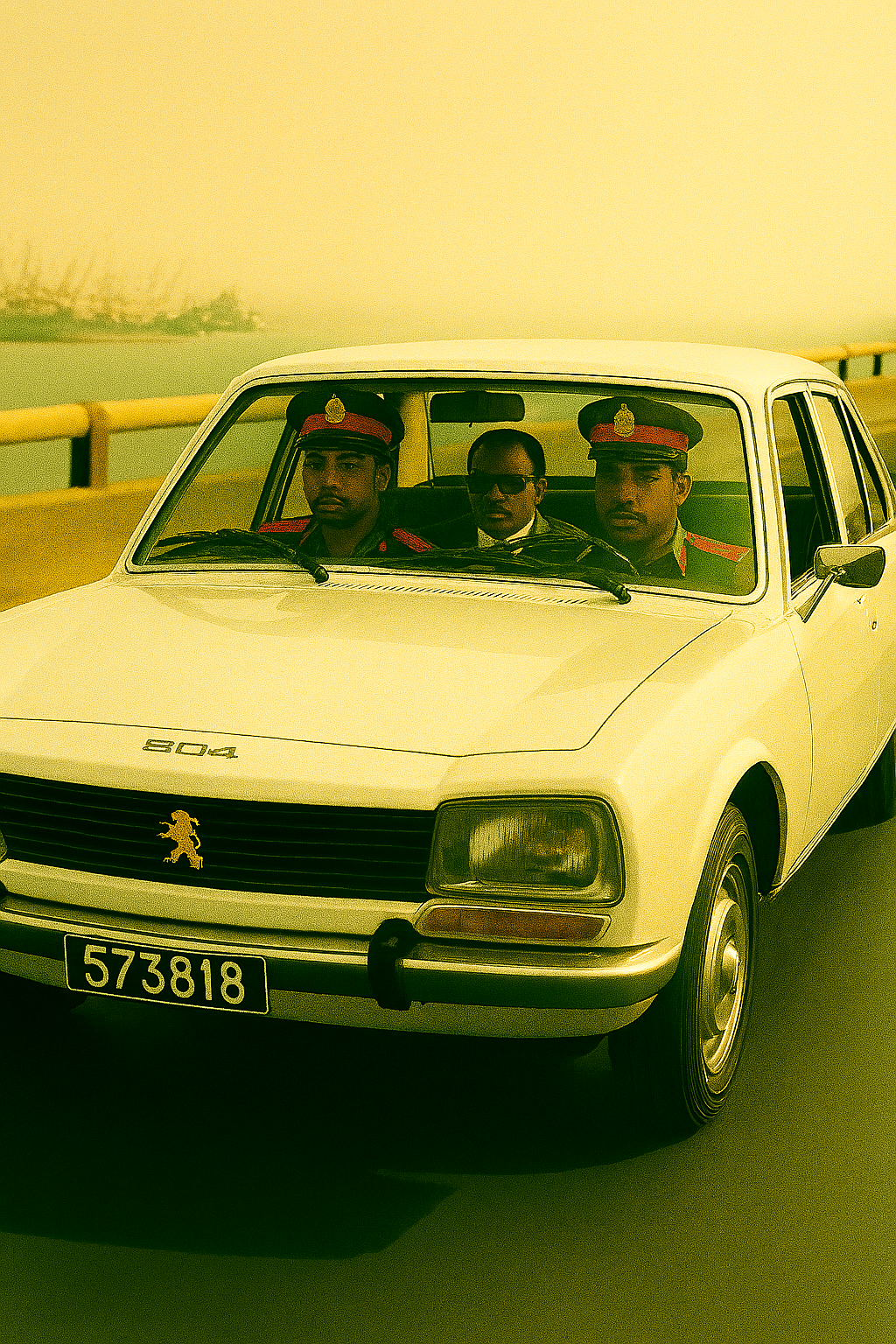
Within minutes of the call, General Gowon, with his service pistol neatly tucked in his dress, was in an unmarked vehicle, accompanied by his ADC, heading towards a private residence in Victoria Island. The drive was short, out from the barracks on Ribadu Road, they soon joined Awolowo Road, crossing the Five Cowries Creek. Gowon could see the lights from ships waiting to berth at Apapa port in the distance. He remembers the approval request on his table relating to this. The vibrant Victoria Island night, illuminated by streetlights, was alive with activity. Just past the Federal Palace Hotel, before reaching the School of Oceanography, they made a right turn onto a suburban street lined with trees. The area was quiet and serene, with only a few individuals seen near the expansive gates of the houses.
At the end of the street, they arrived at a cul-de-sac and drove through a massive golden gate flanked by sculptures of giant leopards painted white and perched on elegant pedestals. The palatial building, with its rear façade overlooking the tranquil Lagos Lagoon, exuded grandeur.
Opening the giant mahogany entrance door was a housekeeper dressed in blue with a white apron. She couldn’t disguise her astonishment at seeing the all-powerful head of state clad in a casual Danshiki and a matching cap. She had always seen him on the news, dressed in an immaculate military uniform. For a few seconds, she was confused about what to do, a mix of excitement and fear overtaking her. She soon regained her composure and walked them through the grand entrance hall.
Here, they were greeted by a gallery of portraits, each depicting Chief Fajemirokun, a renowned shipping magnate, cocoa trader, and entrepreneur with global reach. The photographs showcased his meetings with presidents from various countries, primarily in West Africa.
One portrait, however, stood out. The picture was dated 1967, making it recent. It alone served as a testament to Fajemirokun’s international influence, with all the other pictures confirming this testimony. It captured a momentous handshake between Fajemirokun and the President of the United States, Lyndon B. Johnson. The backdrop was the iconic Oval Office, but the desk in the picture was different from the Resolute Desk that Gowon knew was used by U.S. presidents. The picture looked suspicious, and Gowon made a mental note to ask the Chief about it.
At the end of the hall, she opened a door and ushered the Head of State and his ADC into a private meeting room. Their timing was impeccable. As they were being ushered in, a speedboat arrived at the back of the house, carrying Louis Farrakhan, the emissary of Elijah Mohammed.
As the saying goes, secrets are hard to keep. News of the Swiss companies’ clandestine activities had reached Elijah Mohammed, the charismatic leader of the Nation of Islam in Detroit, Michigan. Recognising this as a form of neo-colonialism, he was determined to prevent it from causing further chaos in Nigeria, which was already grappling with internal strife. However, the question remained: how could he get this information to those in Nigeria who could take action?
Elijah summoned Louis Farrakhan, his trusted aide, and tasked him with delivering the message to Nigeria with specific instructions to seek an audience with General Gowon. He was also to route his way back through Ghana to deliver the same to the boys in uniform in government.
The meeting had to be conducted in utmost secrecy. Neither Chief Fajemirokun nor Gowon was aware of the full extent of the message. Louis Farrakhan had mentioned that his instructions were to deliver the message personally to the Head of State outside of Dodan barracks.
Now, in the meeting room, Chief Fajemirokun stood up to welcome Gowon and Farrakhan. The Head of State took his seat, his face a mix of concern and anticipation. The Chief and Farrakhan sat closely together at the middle of the long, polished table. Gowon then invited his ADC to take notes as Farrakhan, a slender, wiry man known for his fearless pursuit of justice, spoke, his eyes filled with a steely determination.
“Your Excellency,” Farrakhan began, his voice low and urgent, “I come bearing troubling news. There is a price conspiracy afoot, orchestrated by the Swiss, which is crippling the cocoa market.” Gowon’s brow furrowed. The cocoa industry was a vital part of the nation’s economy. Any disruption to its supply or pricing would have devastating consequences.
As Farrakhan outlined the details of the conspiracy, Fajemirokun listened with growing unease. His international shipping and cocoa merchandising businesses were particularly vulnerable to such schemes. The reduced cargoes and increased costs he had been experiencing suddenly made more sense. Not that he had no inkling of what the problem was, being from Ile-Oluji and having most of his cocoa supplies coming from there, he knew that farmers were hurting, as the marketing board prices do not guarantee farmers a living wage. He now understood more the increasing demurrage costs he had been incurring as his ships were spending more time at their ports of call waiting for Cocoa cargoes that never arrived.
Gowon listened with rapt attention, asking only a few questions. When Farrakhan had finished, Gowon thanked him for the information. “We will investigate this matter thoroughly,” he assured Farrakhan and asked him to send his greetings to Elijah Mohammed. Within minutes, Farrakhan was escorted from the hall and departed on a speedboat. Gowon and Fajemirokun were left alone to discuss the implications of the revelation.
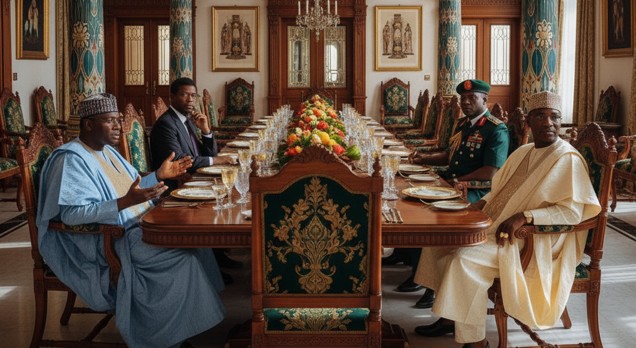
Over a lavish dinner, the two men delved into the details of the conspiracy and its potential impact. Their conversation revealed a deep-rooted friendship and mutual respect. As they talked, it became clear that the price of cocoa was more than just a financial issue; it was a matter of national security and economic well-being.
It was during this discussion that Gowon brought up the peculiar desk depicted in the picture at the entrance. Fajemirokun was surprised by Gowon’s keen observation, replying, “You’re the only person who’s noticed this, which speaks volumes about your military training, sir.”
Fajemirokun went on to explain that he had inquired about the absence of the Resolute Desk during his visit to the White House. Lyndon Johnson had revealed that there were a few reasons why he didn’t use the Resolute Desk. Firstly, as a large man, he found the desk to be too small and uncomfortable. Secondly, following John F. Kennedy’s assassination, he wanted to distance himself from his predecessor and requested a new desk to symbolise a fresh start.
Gowon made a mental note of these details, thanking the Chief for the enlightening explanation.
Following the dinner, on their way back to Dodan Barrack, his ADC said, “Sir, there’s a matter I’ve been wanting to discuss with you. Given our recent meeting, I think it’s important you know.
“You know you can discuss anything with me. What is it? Is Madam pregnant again?”
The ADC smiled wryly. “Not that, sir. This is a significant issue concerning Western State.”
“Okay, go on. You have my full attention.”
The ADC then briefed Gowon on a conversation he had had with Sam Okafor, a fellow townsman and the Divisional Police Officer in Akanran. Okafor had informed him about a meeting of the Agbekoya and their efforts to mobilise widespread support for their resistance to the new taxes imposed by the Western State.
Gowon was alarmed. How had the intelligence reports missed this, and why hadn’t he heard anything from the Governor of the state?”Thank you very much for this invaluable information.
Please convey my gratitude to Sam and ask him to keep you updated on any further developments.”
The shrill alarm on the wall clock pierced the silence, it was time for a break. A low, insistent growl from her stomach confirmed it; she’d been so engrossed in her writing that the meal delivered to her suite was now a forgotten, cold lump.
As if on cue, Mulika walked in with a warm, knowing smile. In her hands was a pack of food. She had just returned from her hospital visit but had made a stop at Alhaja’s buka in Yemetu. “I knew you wouldn’t have eaten,” she said. “I brought us both some Amala with Abula.”
After the last delightful bit of amala had been consumed, Moria couldn’t resist. Old habits die hard, after all. She used her fingers to scoop up the last clinging bits of soup from her plate, eventually taking to licking it clean. From the corner of her eye, she caught Mulika watching her, her shoulders shaking with silent laughter.”
You mean, years in America haven’t taken this from you?” Mulika finally managed to ask, in a voice laced with amusement.Moria simply winked in response, her focus still on the delicious dregs. “The food was too good to waste even a single drop,” she finally said.
The two friends spent the rest of the evening catching up, mostly discussing Mulika’s recent visit to Adeoyo Hospital and her health challenges. Later, they decided to take a walk through the hotel’s expansive grounds. They found a quiet, undulating hill and lay flat on the cool, green grass, watching the sun dip below the horizon over Jericho.
Breaking the comfortable silence, Mulika’s voice was soft but full of emotion. “Moria, thank you for remembering me. I know you could have easily visited Ibadan without reaching out.”
Moria didn’t need words. She simply pulled Mulika into a tight embrace. “You deserve better,” she said. “Life can be unfair, and you’ve been served the bitter part of it.”
As the evening chill set in, they made their way back to their presidential suite in the hotel. A final, heartfelt hug in the lounge before they retreated to their separate rooms.
Moria was just about to undress for a shower when she heard footsteps behind her. Turning, she saw Mulika standing in the doorway, their eyes meeting in the dim light. It was Mulika who spoke first, her voice a little hesitant. “Moria, I’ve been meaning to ask you…are you married? Do you have kids?”
A mask of sorrow fell over Moria’s face. She turned away, hiding the tear that had sprung to her eye. “I’m tired now,” she said, her voice strained. “Let’s talk about this tomorrow.”
Mulika’s shoulders slumped in instant regret. She hadn’t meant to bring up something so painful. Without another word, she quietly slipped back into her own room, leaving Moria alone with her thoughts.